Welcome to L-36.com
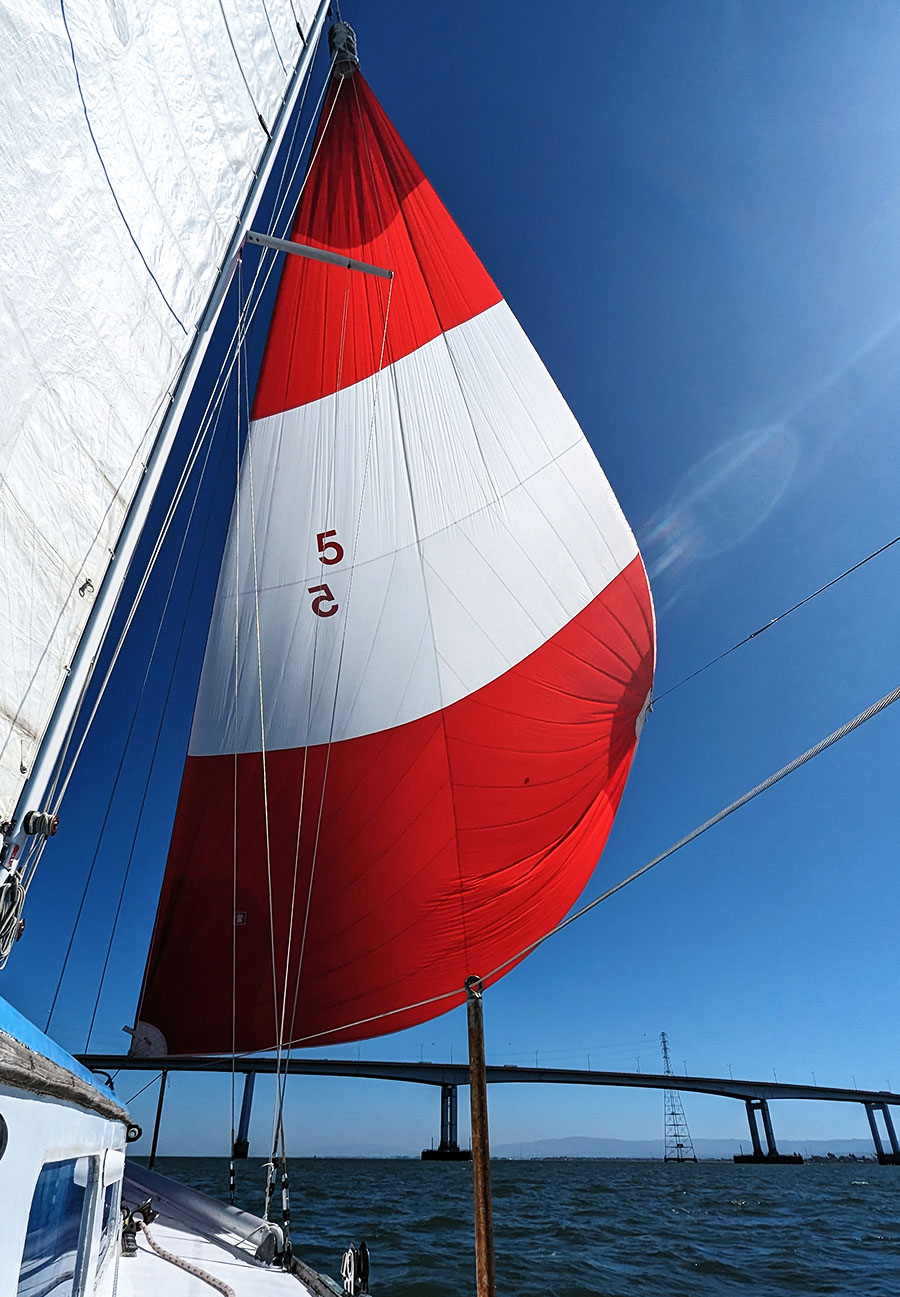
![]() How to Fly a SpinnakerI have had Papoose for 23 years and never used a spinnaker on her. Last two seasons we won the local beer can series using a free flying jib downwind sometimes along with our normal jib. But we always had to play catch up to the boats that used spinnakers. I decided to learn to fly a spinnaker so we could move to the next level. I joined the crew of a very successful Tarten-10 for the winter series. I also bought a GoPro camera to document as much as I could. This training series of articles is the result. It will be updated as I get better video. It will also be updated as comments come in. Lazy Lightning (the T-10) uses end for end gybes which are said to be appropriate for boats up to 35 feet. Read More ![]() Weather Page UpdatesIt has been about a year since I reported on the L-36.com Marine Weather page. There have been many improvements to the page in that time that I want to share. The page has been well received and has hundreds of users. I thought it would be useful to point out some of the improvements for those of you who have not tried it recently.Read More ![]() Wind Map
This is an experimental page that will show the wind for nearby reporting stations. There are three sources of reports: Local and regional Airports, NOAA Buoy Data Center, and Local weather stations. The local version of this page uses all three. The wide area only the official stations which are from the first two. Please check out this site and give feedback. What do you like and what do you want to see added or changed?
Read More ![]() No Shackle Toggle Halyard
|
| A 8:1 Vang system that is cheaper than using two fiddle blocks, lighter, and stronger. What is not to like? You just run the control line back to the cockpit where you put a cam cleat. You will likely need a turning block on deck but then you have the vang where you want it when it needs to be released quickly before you round up. The second vang system shown is the 20:1 vang on Papoose. This is a unique system with some advantages that are discussed. This page also has a link to 16 standard variations on vang systems. |
Read More

Eventide Sails Again
| I am happy to report that the L-36 Eventide returned to the Bay on New Year's Day 2012. After our very well photographed adventures at the 2011 Master Mariners Race I faced a tough decision about whether to restore Eventide. Her hull had basically been sawed through from deck to just above the water line by the other boat's chain link bobstay, and her spruce mast and boom were shattered into multiple pieces beyond repair. Eventide had been so thoroughly restored by her previous owner "Chairman" Bob Griffith and given me so many good times that I decided that if I could find a used and affordable mast and boom that the hull was worth repairing. |
Read More

Creating the Easy to Use Waypoint and Route Program
This winter I am racing on a Tartan-10, not my L-36. We are racing the winter series out of South Beach Yacht Club and another one out of the Golden Gate Yacht Club. The skipper doesn't use a GPS and as I find them indispensable in sailing to a mark and in calling the layline, I brought my wrist version along. But first I needed to program in the waypoints and routes. What a pain. I used OpenCPN and plunked a waypoint down over the marks on the map. Entering the routes was the most difficult. That led me to build the waypoint and route editor. Then I thought, wouldn't it be great to just have a list of all the marks in the area and just check them off, rename them to match the names the race committee uses, import them into a program, copy and paste the race committee routes onto a page and press a button (after a little editing perhaps) and have a file you could download into your GPS? So I built just that.
Read More

Lazy Lightning racing toward the Bay Bridge
GPS GPX Batch Waypoint and Route Creator
|
Entering routes into a GPS when you have a number of them to enter is easy with this bulk route editor. Import waypoints from a gpx file or enter directly into this page, then simply write out the routes all at once and create a custom gpx file with the waypoints and routes ready for export to your gps device or chart program. As an added bonus, Latitude and Longitude can be entered in almost any format, even both in one input box, for ease of copy and paste entry. |
Read More

Latitude Longitude Converter
Convert between different latitude and longitude formats. Then copy and past the converted format into other programs. This program will take most any format as input and outputs the result in five different popular formats.Read More

Gross Fine Mainblock Reeving
![]() |
Two ways of reeving the mainsheet in this gross fine mainsheet system are shown. The more obvious way to do it is shown on the right. The problem is that the lines hit each other, the fine control blocks hit the main sheet, and in general it has problems. The other way rotates the main dual block by 90 degrees and has no such interference issues. It also opens up a large space for the fine tackle so that it does not rub on the mainsheet. |
Read More

Soft Line Shackle on a Block
Read More

A Better Soft Shackle
Revised 12/12/2011 -- added calculatorI make and use a lot of soft shackles to attach my jib sheets. The normal soft shackle is rather difficult to open and to milk closed. With age, it gets every more difficult to use. The alterniative Kohlhoff style looks a bit insecure although under load it is perfectly secure. This version is a bit of a hybrid with hopefully the best properties of both. The eye is easy to open but can only be opened just enough to fit the stopper knot through it. Almost any slight force will close it quickly. The basic construction is a passthrough eye, a shackle section of about 2 inches, a passthrough lock and then a bury of the other strand into a body section of about 5 1/2 inches, another passthrough and finally a diamond knot.

Read More

Finding Target Boat Speed to Windward
![]() |
How do we get to the mark fast?When sailing toward the windward mark I always wondered, should I point high, or should I fall off a little for more speed. Some boats are blessed with instruments that give them these answers. They know how high to point and how fast to go to get them to the mark quickly. My boat is simple. I have a hand held wind meter, a knot meter, and a masthead fly. How can I know what the best point of sail is? |
Read More

Try the L-36 Weather and Tide Page Now!
Examples of valid inputs: "San Francisco, CA" "Golden Gate" "Balboa" "Cow Island" "94301"
Read More

User comments about the Weather and Tide Page from Forums and emails
- Your site is now my primary weather information. While I really like the way NOAA provides info at their sites, yours is more comprehensive and easier to use
- Your website is approaching world class. Really Great Job.
- Keep up the great work, The 4 people I sent the link to loved it.....
- Been playing with it off and on all week. It's already replaced my usual weather info site. Excellent work.
- I just wanted to thank you for the terrific weather page. It is my daily go-to page for marine weather. I sail a pair of boats on SF Bay and out of Santa Cruz, and your web site is really extremely handy. It is far better than the "commercial" sites, which is a real tribute given their budgets and what yours probably is.
Read More

Soft Shackles
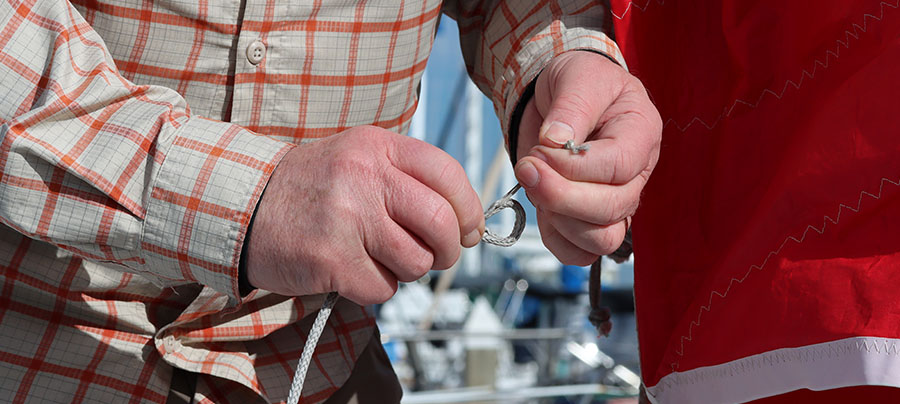
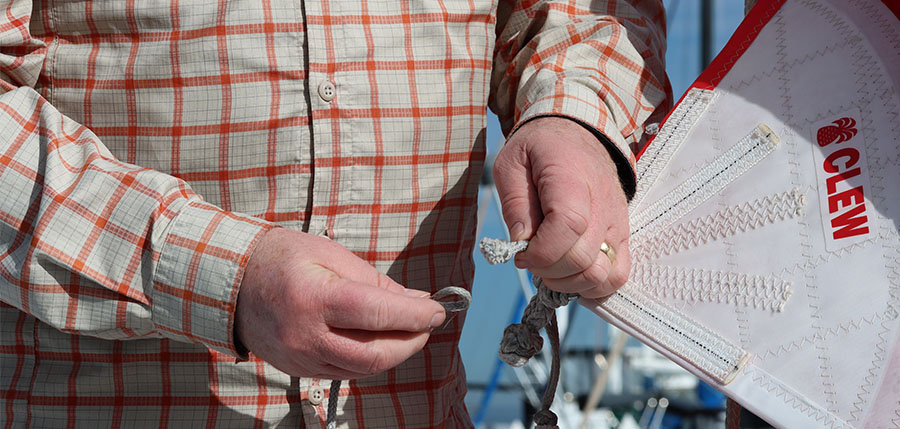
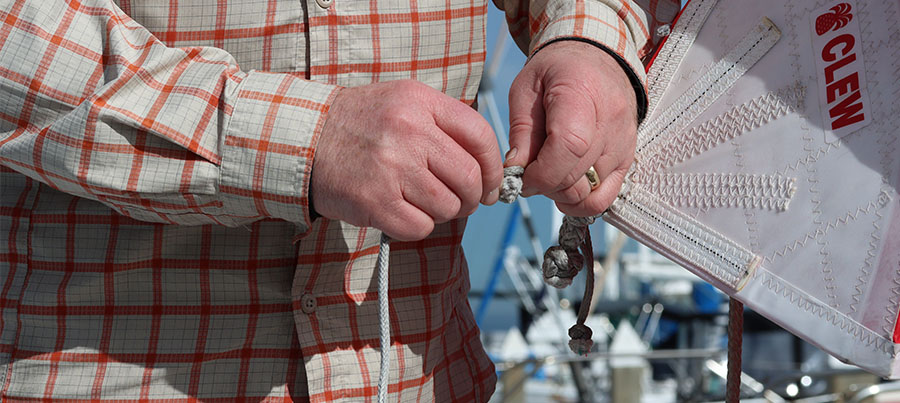
This is the introduction to a series of 6 pages that deal with soft shackles. Step by Step instructions on How to make a soft shackle, some Variations, and some detail on the diamond stopper knot, . . These are incredibly strong. I show how they are used, below. Nothing is useful until it has been tested , so check that page out. There is even a Calculator so you can make them come out the length you want. Enjoy the series. |
![]() |
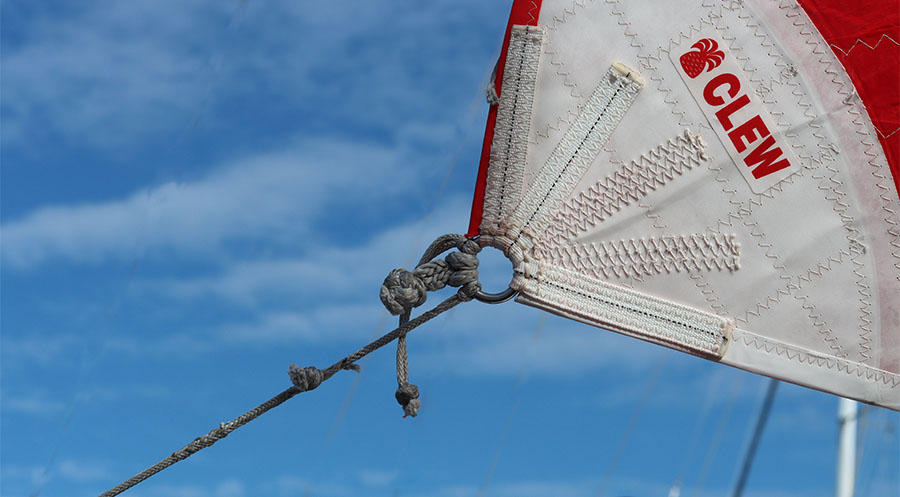
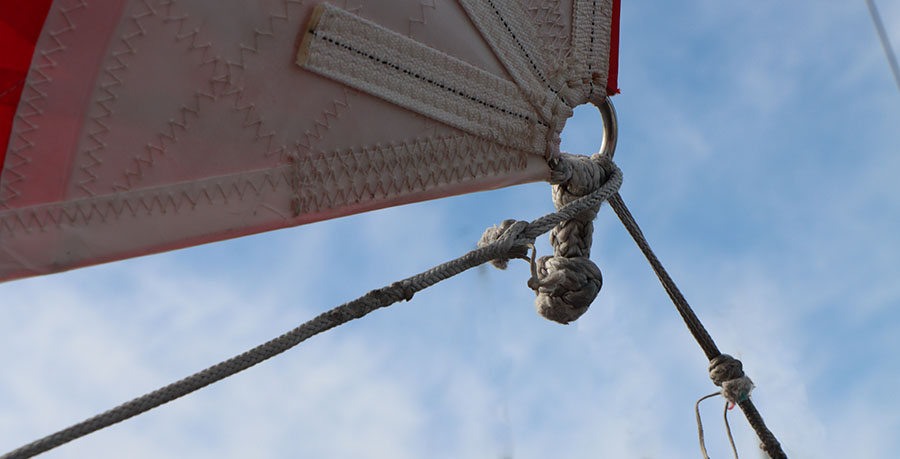
To the left is a picture of the soft shackle on the jib clew. The addition of the Velcro keeps the diamond knot in the center of the clew ring where it will stay out of the way of the rigging. These shackles are very strong. I did some testing and it is clear that the sheet with the eye and the soft shackle is much stronger than the sheet with the bowline. In my testing, the line broke at the bowline. You can follow the links above and see how to make them, as well as the testing that I did. I did the testing at 2/3 scale which is a little less than 1/2 the strength. The test at the bottom of the page was done to distruction of a link line made of the same Amsteel thus showing that a soft shackle is stronger than the line it is made from. On the rest of this page, I show how to use a soft shackle. |
Read More

Weather Reporting Stations
Read More

Double Soft Shackle
This double ended soft shackle is the 4th generation of a design that can attach to a pair of eye spliced jib sheets to the clew of a sail very quickly. It is also the 5th version of this generation as improvements were made to make the shackle stronger. In use, the shackle is secure around the jib sheet prior to being "clipped" to the clew. This version is easy to make and has the advantage of a non-constricting hold on the jib sheets. There are links to the previous versions at the bottom of this page
The Shackle

Read More

Main Halyard Soft Shackle Variation
![]() | This soft shackle in integral to the main halyard. It is made from a single line with a combination of knots with a finishing splice. I have tested it to over 1000 pounds using 3/16 Amsteel without slip. While I have not tested it to destruction it is very likely that the shackle is stronger than the line so that the failure would be outside of the shackle area. I base that on the fact that the shackle area is made of either 2 or 4 lines so any loss due to the knots is unlikely to bring the strength below line strength. Of course, a halyard is typically not loaded that high as the application is mainly stretch limited. That said, be sure to do your own testing before using this in any critical application. |
Read More


We were happy on Papoose to have won our class but sad that one of our fleet was so badly damaged. Eventide was damaged just before the start by a boat from another class.
Read More

Eventide T-Boned in MM Regatta

"Eventide was badly damaged at the start of the 2011 Master Mariners. She is safe in her slip in Berkeley and I am making a plan and exploring options for repairs and replacement rigs. I am extremely grateful for the support of the L-36 and Master Mariners community. Damage appears to be limited to her planking and obviously her rig. I will keep the L-36 community updated as to her status. Any previous experience or advice on repairing a large section of an L-36's hull is welcome. I can be emailed directly at gregmilano(at)hotmail(dot)com. Thank you for all of your support."
Greg Milano, Eventide
Read More

My harbor early one morning

Soft Halyard or Line Shackle

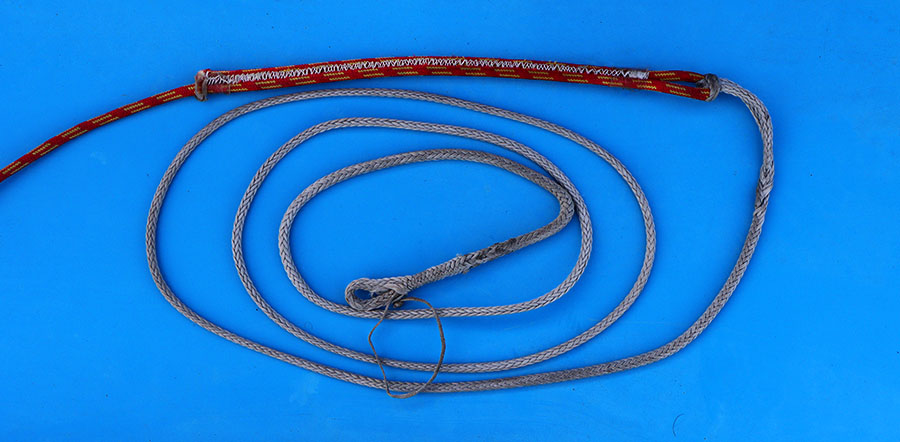
I am calling this a soft halyard or line shackle as it is certainly not confined to use only on halyards. It is a combined splice-shackle and is similar to a soft shackle where the opening eye is on the line and the knot is on a second piece. It is much faster to use than a soft shackle. In applications where the line is 12 strand spectra such as Amsteel, this is a perfect fit. I have tested it to destruction and the failure was similar to other tests of soft shackles which broke at the diamond knot. Based on all these tests, my conclusion is that it is 80-90% as strong as the line. I must add, the force I put on my 1/8 inch Amsteel using a hydraulic jack was huge, many times the force I got using a Barient 22 winch even with 1/8 inch line. In other words, this is a strong, easy to use shackle is integrated into a line such as a halyard. The line in all these photographs is 3/16 Amsteel Blue.
Read More

The headline reads:
Lightning strikes a boat in Wisconsin and the boat sinks in less than an hour......
On Wednesday, June 8th, 2011 as the sailboat fleets made their way in from the evening races, they were glad to beat the thunderstorm that was coming in from the west. Just at dusk eye witnesses saw a lightning bolt hit a 30 ft ketch swinging on a mooring in McKinley harbor, downtown Milwaukee. " It lit up like a Christmas tree" was how one observer described the event. Within an hour the boat was under water with just portions of the masts showing.Through Hull and Bonding
Notice the wire going to the through hull in the picture below. Also notice the grounding clamp around the through hull where the connection was made.Read More

Bonding and Corrosion
There are few if any topics in yachting that have as much myth and misinformation surrounding them as does the question of bonding various pieces of your boat together. There is a very good reason for this confusion as the requirements surrounding bonding conflict. It is important to understand when bonding is good and when it is bad so that you can know when you should and when you should not bond. I hope this article will help to clear up some of that confusion. I will try and present the topic in an understandable way so that you can make decisions based on knowledge rather than on opinion or myth.
The "big picture" questions that need to be answered are:
- What does bonding actually do?
- Why do you want to bond pieces of your boat together?
- Why do you want to have pieces of your boat isolated (not bonded)?
If we can answer these questions we can make intelligent decisions about what to do.
What does bonding actually do?
Read More


Two TP-52s

Inhauler
An inhauler, sometimes called a Barberhauler, is used to pull the jib sheets inboard from their normal position. You can do that to decrease the sheeting angle or to keep the sheeting angle the same as you let the sheets out to add fullness. We do that when we need more power to drive through the waves. In flat water, we don't use it so we like to have it detachable and easily set up. This setup stores nicely and can be quickly installed on the already set sail. The carabiners I use are very light so they do not harm the paint on the deck. Them and the descending ring are from REI and their 5,000 pound rating, typical of climbing equipment, is ideal for my boat. Get the carabiners with the wire gates.This is generation 3 of my inhauler setup. It is easier to set up than the other versions. The 8:1 purchase seems ideal for the job and the fact that one control line works both port and starboard is a great advantage. Once balanced, you are automatically maintain your trim after a tack. I like to rig my double block so the line is against the deck instead of the face. You can see that in the pictures below.

Read More

Knot Meter Calibration
In many area calibrating a Knot Meter is a simple matter of setting it to read what the GPS reads. But if your boat is in areas where there are tides, local current can make this method inaccurate. The following method can be used to calibrate a knot meter even if there are very strong currents.Read More


Samba Pa Ti and GG Bridge

Over 200 Marine Manuals
Listed AlphabeticallyRead More
Boat Dimensions
BOAT |
I |
J |
P |
E |
ISP |
JSP |
PY |
EY |
| Lapworth 36 | 40.5 | 13.5 | 35.5 | 17.5 |
Click Here for other boat types
Sail Area Calculations
Mainsail = (P x E) / 2 = 311 sq ft
155% Genoa = (( J x I ) / 2) x 1.65 = 451 sq ft
Read More

Two Melgeis 32's on split tacks heading to the windward mark
Article Index
Boating Related
- How to Fly a Spinnaker
- No Shackle Halyard
- Vang Systems
- Evantide Sails Again
- Easy GPS Waypoints and Routes Creation
- Gross Fine Mainblock Reeving
- Finding Target Boat Speed to Windward
- Bonding Sinks Boat
- Inhaulers
- Calibrating your Knot Meter
- Printing your own NOAA Charts
- Repowering your Sailboat
- Amsteel to StaSet Splice
- Jib Twing
- Bonding your boat
- Lightning on a Sailboat
- Humidity Below Deck
- Low cost High Tech Halyard
- Mainsheet Systems
- Rig Tuning
- Loos gauge accuracy
- Foot Block Wedge
- Replacing Cockpit Drains
- The San Francisco Bar
L-36 Articles
- Insurance
- Tuning the rigging
- Boat of the Month (L-36)
- Chariman Bob's list of concerns about L-36s
- From Odin Braathen
- Swiftsure (1959-1970)
- L-36 Class History
- Remembering Bill Lapworth
- Remembering Chairman Bob
- What is the handicap of an L-36?
- Repower
Wood Boat Articles
- Inspecting Wood Boats
- Cockpit Repair
- Repairing cabin top leak on Papoose
- Repairing a pulled up rail track
- Wood Boom Repair
Reference Index
Screws and bolts
- Wood Screws
- Pilot Holes
- Machine screws
- Screw Heads
- Screw Length
- Nuts
- Washers
- Hex Bolts
- Torque
- Torque
- Wrench Size
Taps, Threads, and Drills
Winches
Metal
Engines and Manuals
Line and rigging
- Knots, Splices, and Rope Work
- Diamond Knot.
- Splicing
- Block Systems
- Loos PT Gauges
- Breaking Strength
- Knot Break Strength vs Rope Break Strength
- Line Selection guide
- Jibsheet Load Calculator
- Twine Size
Navigation
Sails
Misc
- Conversion
- Manuals.
- Fraction equivalent
- Sealants
- Table of Daylight Savings Time
- Find the Latitude and Longitude
- Marine Zone
L-36 Specific
|
Web design by Allen Edwards ©2007-2012 Allen Edwards |
L-36.com is owned and maintained by me, Allen Edwards, owner of Papoose hull #5 built in 1956. I also own Allen Edwards Photography. Please visit at Palo Alto Photo . com |
page processing time
was 0.35 seconds |
This is an experimental page that will show the wind for nearby reporting stations. There are three sources of reports: Local and regional Airports, NOAA Buoy Data Center, and Local weather stations. The local version of this page uses all three. The wide area only the official stations which are from the first two. Please check out this site and give feedback. What do you like and what do you want to see added or changed?
UPDATE: New configuration shown!